


Community
Entering into A Midsummer Night’s Dream

Just a few days ago, somebody tried to drug a young man so he would begin to love a woman already in love with him. The love potion was accidentally administered to the wrong man.
This actually took place on the NIC campus.
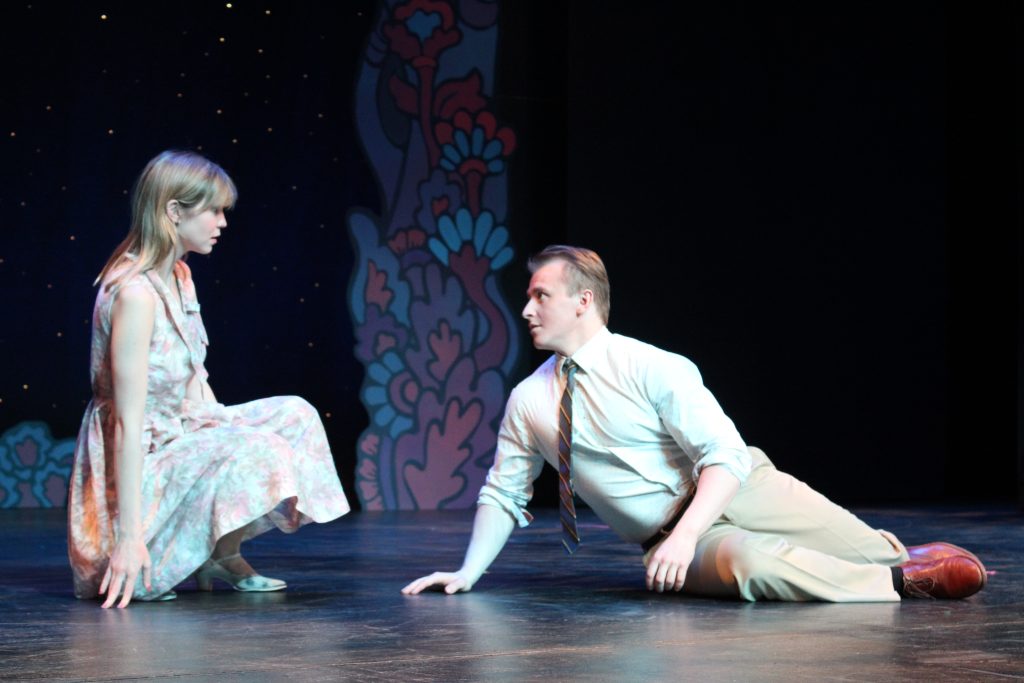
The theater department enacted this scene onstage during their Spring 2022 production of “A Midsummer Night’s Dream.” For six evenings, the interference of fairies into human affairs initially disturbed but then healed love. The director still considers the work one of Shakespeare’s most popular.
Fairies in ancient Greece have noticed several lovers are struggling: one because a parent disapproves, the other because love is unrequited.
Egeus, an upper-class businessman, tries to dictate whom his daughter Hermia should marry, at one point having the Duke of Athens to demand her obedience.
LCSC student Grant Benjamin had already played the stereotypical, controlling parent in other plays. He felt this time was more intense because Egeus is more serious and stuck-up than previous roles.
Benjamin said he sees acting as a form of escapism - all concerns are left at the door. This has kept him returning each year.
“The play is the thing,” Benjamin said.
NIC Professor Geoff Carr, played the Duke of Athens, Theseus, and the king of fairies, Oberon. He said it was a challenge to keep the two characters distinct, although the practice is not uncommon in theater. He accentuated the distinction by using clearly different costumes, hair, and voice. Of these two, he definitely has a favorite.
“I am most fascinated by Oberon,” he said.
Oberon’s quarrel with the queen of the fairies causes all sorts of chaos, since he sees love potions as the solution to his problems.
He is other-worldly and completely unique, a character Carr has always thoroughly enjoyed. He said he was inspired by Dream from the “Sandman” comic strip, using some elements of that character that worked with this play.
“There was this one line that struck me. ‘Oh I know how to say that!’ And that’s something that happens a lot,” he said. “It was a bunch of names…I didn’t really know those names either, but I knew what the motivation was – it was to make her jealous. I knew how to say those names.”
This line had originally been cut from the play since it was more obscure, but Jacoby reinstated it after hearing Carr act it out. It has since become Carr’s favorite line from the play.
This is the only play Carr has performed multiple times, and was also the subject of his first play ever. He hopes that everyone else is inspired to up their game when they see he is experienced.
“I want to make each line like a song and I want to make each melody different."
Professor Geoff Carr
He is especially impressed by those with the role of lovers in this play. Despite their predictable role, he saw them generate as much humor as the most comical character of the play, Bottom, who wears a donkey’s head.
“I am sure there are people on this cast who are very worried about particular times on stage, where they don’t want to laugh because they are going to break character!” Carr said.
Much of Bottom’s humor comes from trying to sound smart, drawing the most laughs during the final scenes. Carr said that although the play belongs to the genre of comedy, it might not be quite what the audience is familiar with.
The servant-fairy Puck was Helen Larreau, a NIC student who loves acting as an avenue for self-expression and genuine moments. Puck is usually seen as mischievous, but Larreau also wanted to focus on his playfulness, appearing youthful through loose arm movement.
The Oberon and the fairies exercise great influence on the humans throughout the play. The drama builds as fairy interference goes wrong. However, even after the fairies heal the damage, it is human leadership that decides the fate of the lovers.
Helena, a close friend of the persecuted Hermia, is actually in love with Egeus’ choice for Hermia, Demetrius. The king of the fairies intends for Demetrius to return her love, but his servant blunders, leading to the bewildering and bitter exchanges of the two couples.
“O me! -- you juggler!” shouts Hermia. “You canker-blossom! You thief of love!”
Karissa Walterman played Helena, engrossed with love the whole play through. Although she realized the man was not worth such affection, yet she could identify with Helena.
“It is very life and death being in love,” she said. “When you love someone and they don’t love you back – it is the worst feeling ever!”
Walterman, as a member of the community, has been in several NIC plays.
She felt Helena’s personality is impulsive and dramatic - even silly. She puts on a big “pity-party” and shares her heart with the audience so they will take her side.
"It [the play-within-the-play] is so cobbled together and ridiculous that I often find myself laughing during the rehearsals."
Lillian Maria-zeagler
The director, Professor Joe Jacoby, was quite familiar with the play, especially since “A Midsummer Night’s Dream” was his first production as a full-time professor. This performance was to be different.
He said the ‘60s were a particularly good setting to contrast two different worlds. Traditional values were challenged by counterculture.
Carole Urquhart, the costume designer, recognized this juxtaposition of the free-and-easy world of fairies onto the rigid human realm, highlighting the contrast through costume selection.
These two realms meet in a forest, where the majority of the play is set. As is often the case, the forest is a magical place where all things can come together, unifying a work full of what Jacoby calls anachronisms (juxtapositions of people, customs and events from different times).
The performance opened with the dark, military uniforms of the aristocracy of Athens. By the end of the play, interaction with the hippie, fairy world changed the humans. This was shown by changing costumes to be lighter and happier.
Jacoby is wary about modernizing older plays. If the director’s critique of a period is too obvious, the performance could resonate less with the audience, or limit how much the audience takes away from it.
“We have to make sure we are telling the story well and then trust the audience to understand and go with you on that ride,” he said.
The fairies exercise great influence on the humans throughout the play. The drama builds as fairy interference goes wrong. However, even after the fairies reverse the damage, the fate of love lies with human leadership.
He does not expect the audience to come prepared. If they do not like the performance, the blame lies with the cast, before it does with Shakespeare. One of his favorite questions to the actors is “What are you saying here and why?” since it reveals a character’s objective.
“The audience gets to catch you trying to impress – and it is much more believable – we are allowing them to join us,” Jacoby said. “You are entering into another world – and that world is alive.”
When he learned these techniques in theater class, acting became much more freeing and impulsive. His students are also initially nervous about disregarding the director’s instructions, but he feels that only when the actors are surprising themselves, might the audience be surprised and emotionally respond.
He realizes that Shakespeare is still the most popular playwright in the U.S., but not because teachers are promoting him. Audiences actually love the plays: they are still funny and give unique and special insight into the human condition.
The first step in practicing for the play is called “table work”. Since this play has more complex language than most, the first few weeks focus on just the script. Jacoby brought in a lexicon with every Shakespearean word. He felt words provide the most insight into the psychology of the characters.
“If we don’t know what we are saying, there is no way for the audience to know,” he said.
Jacoby feels Shakespeare is excellent actor training since the language is more difficult than in contemporary plays. These skills are important in any performance.
Alana Statham, the stage manager, heard Jacoby announce the play in theater class and attended the first practice out of curiosity. That decided it for her.
“I love how enthusiastic everyone is – I love it!” she said. “After seeing how everyone interacted with each other, I really enjoyed being a part of it. I could really see hanging out with them.”
She had acted in high school but left off for a few years. When arriving at NIC, she intended to be an English major, She soon realized that her interests lay more in theater. Now she even dreams of getting into screenwriting.
When the play entered the second stage of production, the off-book sessions, it was her responsibility to record how faithful actors were to their lines. Meanwhile, the director fine-tuned the play moment-by-moment.
Statham coordinated multiple assistants, including the costume designer. Beginning with tech week, the next step of practice, she ensured light, music and scenery changes were on cue.
Other than a few substitute stage props, the rehearsals were done without costume or scenery until the last few days. Actors are accustomed to forgoing the costumes until the final rehearsals. Jacoby said they used substitutes whenever the costume was unfamiliar, such as a cape.
The costume designer, Urquhart, has worked in the industry for 25 years. It all started in college when she offered to help a friend try on costumes. She realized it was something she was able to do herself. She went on to receive a masters in fine arts in costume, and five years ago became the costume designer for NIC.
In addition to custom-designing each costume, she teaches costume construction and stage makeup to students. Her work takes place away from the action, but she feels that the anticipation and united goal brings all the contributors together.
“On opening night everyone comes together as a team, just like before the big game - there is a real interesting energy,” she said. “Just going to go out and convince them of the world you invented!”
Lillian Maria-Zeagler played Bottom, whose costume included a donkey head, constructed of woven wire and willow. Since it could easily have fallen off, she had to adapt her acting more than she had anticipated.
Before the play she said, “I plan on having fun with the head. My biggest goal is to make people laugh. It's ridiculous and clunky and completely impractical, but so is Bottom!”
Maria-Zeagler said participating in the play has changed how she thinks of Shakespeare.
“I kind of assumed that he was more dramatic than comical. Oh boy was I wrong! Shakespeare can be funny, raunchy, playful, angsty, and, yes, even dramatic. This show has given me a new love for Shakespeare and literature from the Renaissance.”
CORRECTION: The feature photo caption "The king of the fairies, Oberon (Geoff Carr), confronts his queen, Titania (Taylor Wenglikowski), while the fairies (left to right Kendra Marquardt, Yona Soltis, Dimitri Tucker and Hannah James) observe," was corrected as follows:"The king of the fairies, Oberon (Geoff Carr), confronts his queen, Titania (Taylor Wenglikowski), while the fairies (left to right, Hannah James, Yona Soltis, Dimitri Tucker and Kendra Marquardt) observe." The sentence that said, "He (Geoff Carr) started acting when teaching at Georgia Tech" was incorrected and removed.
Updated 4/30/22